
We regularly explore new marketplaces to help you expand your sales channels. Today, we’re looking at car parts on OnBuy
OnBuy is a UK-based marketplace open to registered businesses from the UK and internationally. In addition to the UK, it operates across several European markets, including Ireland, Germany, France, Spain, and Italy.
In this article, we’ll explain how the automotive category works, what types of car parts tend to perform best, what requirements sellers must meet, and how to structure listings effectively. We’ll also briefly cover how to streamline operations if you plan to scale.
Main Automotive Categories on OnBuy
OnBuy’s Cars & Automotive section is organized into clear subcategories for wheels, parts, accessories, and more. Major categories include:
- Car Wheels, Tyres & Trims – covers rims, wheel trims, tyre accessories.
- Car Parts – all sorts of replacement parts (exterior, interior, mechanical).
- Car Accessories – non-essential add-ons (e.g., seat covers, floor mats).
- Motorbike Parts & Accessories – for two-wheeled vehicles.
- In-Car Entertainment & Electronics – nav systems, speakers, dashcams.
- Vehicle Care & Maintenance – cleaning supplies, fluids, tools.
- Garage Equipment & Vehicle Tools – lifts, jacks, diagnostic tools.
What Sells Best in OnBuy’s Car Parts Category
If you’re planning to sell car parts on OnBuy, you should first understand how buyers behave on the platform.
The current structure of the Car Parts category shows strong visibility for accessories rather than heavy mechanical components. Based on the structure of the category and bestseller visibility, OnBuy performs strongest in:
- Car badges and emblems, including branded logo replacements
- Protective and decorative body elements, such as side strips and handle protectors
- LED lighting kits and custom bulbs
- Seat belt accessories like extension straps and padded covers
- Small automotive electronics and interior add-ons
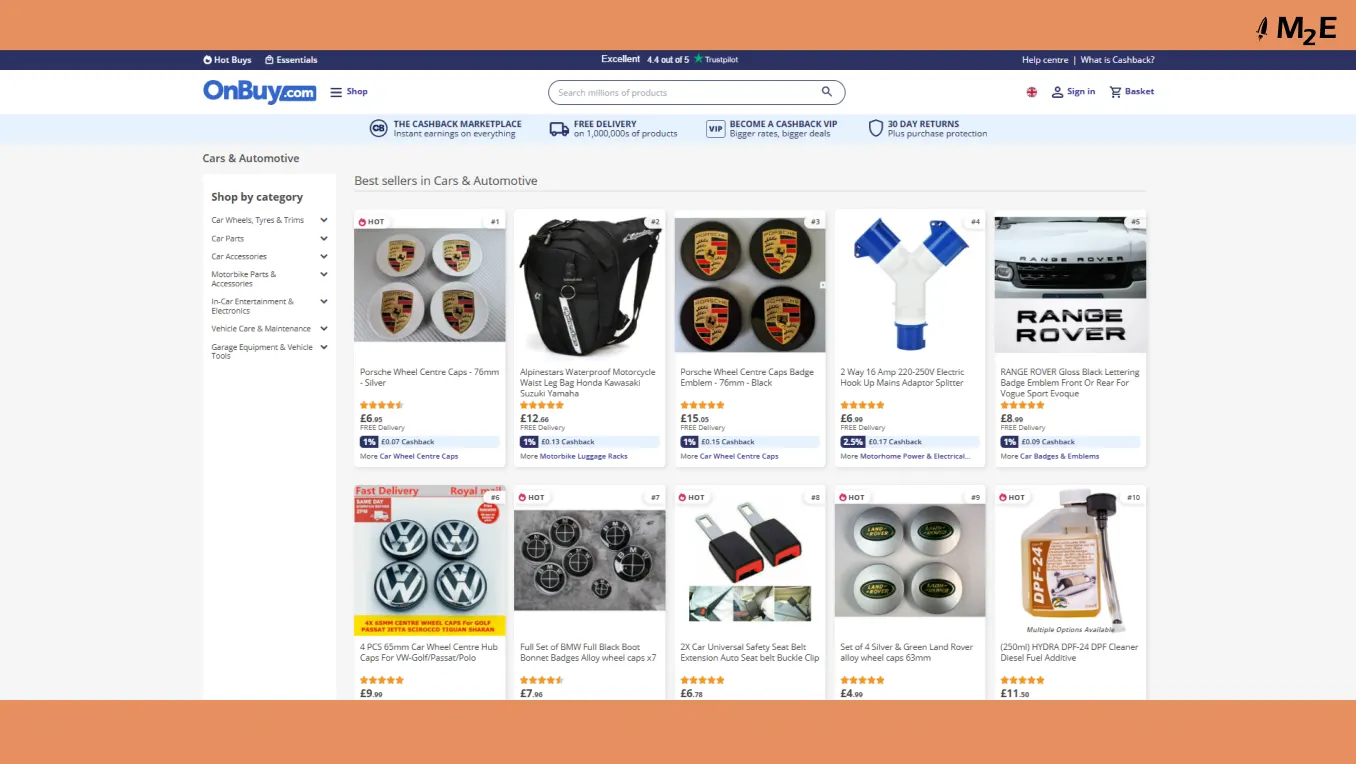
Most of these products are universal or semi-universal. Buyers tend to look for simple upgrades like lighting, styling details, or interior add-ons. These are easier to understand, easier to install, and generally safer to buy online than complex mechanical parts.
For sellers, universal accessories are often the most predictable starting point. Mechanical parts can sell as well, but they require more careful listing and pricing control.
What You Need to Know About Listings and Parts Compatibility on OnBuy
OnBuy does not currently provide a structured vehicle compatibility database similar to eBay Motors. Sellers must communicate fitment details manually within their listings. If you sell technical components such as brake pads, suspension parts, sensors, or engine parts, compatibility must be clearly stated in your title and description.
When creating listings:
- Choose the correct category (typically “Automotive & Motorbike > Car & Car Parts & Accessories”)
- Use clear, keyword-focused titles
- Specify make, model, and year in the description
- Add OEM numbers or part numbers where available
- Provide detailed specifications (material, dimensions, etc.)
- Use high-quality images from multiple angles
- Indicate condition clearly (New or Used, if compliant with platform rules)
Because compatibility is not filter-based, unclear listings increase the risk of incorrect orders and returns. This is one reason universal or semi-universal accessories often perform more consistently on OnBuy.
Product Data & GTINs on OnBuy
OnBuy may require GTINs (barcodes) when available for catalogue creation. For some automotive parts that do not carry retail barcodes, alternative identifiers such as manufacturer part numbers may be used.
Even when a GTIN is not required, key product fields should be completed carefully, including brand, manufacturer, part type, technical specifications, and OEM or reference numbers. Since OnBuy does not provide automated vehicle compatibility, clear and structured product data becomes especially important for reducing returns and building buyer confidence.
If you operate under a registered trademark, you can create catalogue entries under your brand. In automotive, however, private labels typically work better for universal accessories and lifestyle products rather than safety-critical mechanical components, where buyers often prefer established brands.
Seller Requirements to Sell Car Parts on OnBuy
Before you start listing products, it’s worth understanding how OnBuy is structured as a marketplace. The entry criteria and basic operational rules determine whether the platform is a good fit for your automotive catalog.
Eligibility & Application Requirements
The platform also requires a proven selling history. You need at least 50 genuine buyer reviews from the past 12 months, with a minimum of 90% rated 4 or 5 stars. You must submit a link to your existing storefront, such as Amazon, eBay, Shopify, or another online marketplace, so OnBuy can verify performance.
You also need:
- Business registration details
- VAT information (if required)
- A clear returns policy
- A workable return solution for the countries you sell to
The sign-up form takes around 15 minutes. Approval is typically straightforward if you meet the criteria.
Subscription Plans & Commission Structure
Once approved as a seller, you choose a monthly subscription plan. OnBuy operates on a subscription model with no per-listing fees, and all plans allow unlimited product listings across the UK and EU marketplaces under one account.
As of February 2026, the available plans are:
- The Standard plan (£25/month + VAT) is the starting option. It gives you unlimited listings, access to integrations and API tools, and standard seller support. It’s generally suitable if you’re testing the marketplace or running a smaller catalog.
- The Partner plan (£69/month + VAT) adds more visibility and support. You get priority assistance, a dedicated store page, better positioning in search, and the ability to become the main seller shown on product pages.
- The Professional plan (£249/month + VAT) is aimed at brands with larger sales volumes. It includes stronger brand exposure across the platform, a Professional Seller badge, more storefront customization options, and basic account management support.
Commission Structure to Sell Car Parts on OnBuy
In addition to the monthly subscription, OnBuy charges commission on each completed sale. For Car & Automotive Parts, the commission structure is tiered:
- 15% on the first £45 of the sale price
- 9% on the remaining amount above £45
You only pay commission when you sell. The fee already includes payment processing, so there are no additional PayPal or transaction charges deducted from your payout.
Automotive Commission Comparison
| Marketplace | Automotive Commission Structure |
| eBay Motors | ~10–12% final value fee (varies by category and seller status) |
| Amazon Automotive | ~15% referral fee |
| OnBuy Car & Automotive Parts | 15% on the first £45 of the sale price, 9% on the remaining amount |
OnBuy’s tiered structure means commission decreases for higher-priced items. However, commission is only one factor. Competition model, advertising costs, and operational setup also affect your final margin.
Pricing Strategy & Margin Considerations
OnBuy operates on a catalogue model, meaning multiple sellers can offer the same product on one page. If you sell established brands like Bosch, Brembo, or NGK, you will likely compete directly on price. This impacts the margin.
Automotive parts often have tight wholesale margins. After commission and shipping, pricing flexibility is limited, and small price differences can determine who wins the sale. For more stable positioning, sellers often focus on:
- Private label products
- Universal or semi-universal accessories
- Products where they control the catalogue listing
Branded mechanical parts can sell, but they require strict cost control and a clear pricing strategy. Understanding this competition model helps you decide which products to launch and whether OnBuy fits your portfolio.
Fulfillment & Operational Responsibility to Sell Car Parts on OnBuy
OnBuy does not operate its own fulfillment network. Sellers manage logistics independently. You are responsible for:
- Inventory storage
- Order processing and shipping
- Returns handling
- Customer service
All returns are handled directly by the seller. You must provide a clear returns solution and comply with UK consumer protection rules. In case of disputes, OnBuy acts as a mediator. Claims are reviewed under the platform’s Buyer Protection policy, and listing accuracy and communication records can influence the outcome.
There are no separate warehousing or per-unit fulfillment fees from OnBuy. Instead, logistics and return costs must be factored into your pricing strategy.
Optional operational costs may include OnBuy advertising tools, third-party fulfillment providers, or multichannel management software such as M2E Cloud.
Prohibited Car Parts on OnBuy
Before listing automotive products, review OnBuy’s Prohibited Products Policy. The platform restricts certain vehicle-related items for safety and regulatory reasons. Violating these rules can lead to listing removal or account suspension. Key automotive restrictions include:
- Non-certified parts. Car parts that lack required local certifications (such as ECE or CAPA). Always ensure replacement parts meet legal safety standards.
Motor vehicles. Complete cars or motor vehicles are not allowed (with limited exceptions like electric-assist cycles, mobility scooters, kids’ dirt bikes ≤50cc, ride-on toy vehicles, etc.). - Seat-belt alarm stoppers. Devices that defeat or trick seat belt buckle alarms are prohibited. These can compromise passenger safety and are explicitly banned.
- Used catalytic converters. Selling used catalytic converters is only allowed if you are a registered motor trader or licensed breaker. Otherwise, used converters are disallowed on the platform to prevent theft-related issues.
- Used airbags. Second-hand airbags, including those removed from scrapped vehicles, cannot be listed on OnBuy due to safety and regulatory restrictions.
- Seatbelts & components. These items are considered safety-critical and must not be sold second-hand on the platform.
Always review OnBuy’s full Prohibited Products Policy (especially the “Car & Motorbike Parts” section) before listing. Violating these rules can lead to listing removal or account suspension. Stick to compliant items, and explain any necessary product certifications in your listing description.
Using M2E to Streamline OnBuy Sales
If you sell car parts on more than one marketplace, handling everything separately can get messy fast. Automotive catalogs usually include a lot of SKUs, each with specs, compatibility notes, and changing stock levels. Updating listings by hand across platforms increases the chances of pricing mistakes or selling items that are already out of stock.
If you’re already selling on Shopify, BigCommerce, WooCommerce, Shopware, or Salesforce, you don’t have to build your OnBuy catalog from scratch. M2E Cloud is preparing a dedicated OnBuy marketplace integration (coming soon). Once available, it will allow you to connect your existing store and publish products to OnBuy in bulk, keeping stock and pricing aligned with your main catalog.
If you’re on Magento (Adobe Commerce), M2E Pro works directly inside your Magento backend. You manage OnBuy listings there, match products to categories, and keep stock and orders in sync without switching between platforms.
With either integration model, sellers can:
- Synchronize inventory and pricing in real time
- Import and manage OnBuy orders from a central system
- Publish and update listings in bulk
- Maintain consistent product data across channels
For automotive sellers managing large catalogs, structured integration reduces operational errors and supports expansion into multiple OnBuy marketplaces across Europe without duplicating listing work.


Conclusion: Sell Smarter on OnBuy with the Right Setup
Selling car parts on OnBuy is realistic – but execution matters. Without automated fitment, your listings must be clear, structured, and compliant. OnBuy offers transparent subscription plans and commission rules, but you manage logistics, returns, and data accuracy yourself. If you operate a large catalog or sell across multiple channels, manual updates quickly become inefficient.
Tools like M2E Cloud (for Shopify, WooCommerce, BigCommerce, Shopware, and Salesforce) and M2E Pro (for Magento) help centralize listings, pricing, and inventory so you’re not managing everything twice.
For many sellers, OnBuy works best for accessories and universal parts. With the right setup, it can become a solid additional sales channel without adding unnecessary operational risk.

